
Beyond Flexibility: How Yoga Builds Functional Strength for Athletes
Most athletes underestimate the value of yoga as they see it as an exercise for recovery, to be done when feeling tired or when they are injured. However, this view of yoga is totally inaccurate. Yoga, when regularly and properly performed, is a mechanism for building strength and overcoming the areas where traditional gym workouts may not contribute to your progress.
One important aspect of yoga is that it is “functional.” This means that when you are in a pose such as Warrior III, which involves balancing on one leg, every tiny muscle from your foot up through your core and into your hip is activated in order to keep you steady. There is no machine there to assist you in the movement and no symmetry in the pose to allow you to “cheat” your way through it. The result is that your nervous system is activated and engaged. It is this exact mobilization of your nervous system that directly impacts your athletic performance.
The point of this is not to become more flexible, as many people might think, but to access your full strength by creating total body coordination and control.
The Strength Hiding Inside Stillness
Holding your body in one position for an extended period of time may not sound like a challenge compared to other intense physical activities, but it actually recruits a lot of different muscles and strengthens your body in ways you might not expect. For example, a 60-second Plank may not seem too difficult compared to a heavy deadlift, but in that time you’ve engaged your transverse abdominis, obliques, and deep spinal stabilizers. These are the muscles that protect your spine when you’re faced with opponents in contact sports, come crashing down from a block or a rebound, or power through a water-based stroke.
Then there are the transitions from one pose to the next. When you move from one shape to another very slowly, your muscles come under eccentric load: they’re lengthening while under tension. This is one of the most effective ways to increase the resilience of connective tissue and it’s something you don’t get from a lot of programs that focus on improving concentric strength.
Research from the Journal of Physical Therapy Science shows that regular practice of yoga poses enhances isokinetic muscular strength and explosive muscular power. Core muscle endurance also rose by up to 25% in some people after 12 weeks. These aren’t random numbers. These are the numbers you can quantify.
Kinetic Chains vs. Isolated Muscles
In traditional resistance training, one muscle or muscle group is trained in isolation. Each exercise attains a specific objective and goal. Leg press – for quads! Cable row – for lats! This is exactly what athletes don’t do (train or move in isolation!). Sprinting, throwing, changing direction – everything you do in sport moves the body along fascial lines. These are uninterrupted tracks of connective tissue running from the foot to the shoulder. If one component of the kinetic chain is weaker than the rest, this weakness is compensated in the chain, and that’s when overuse injuries occur.
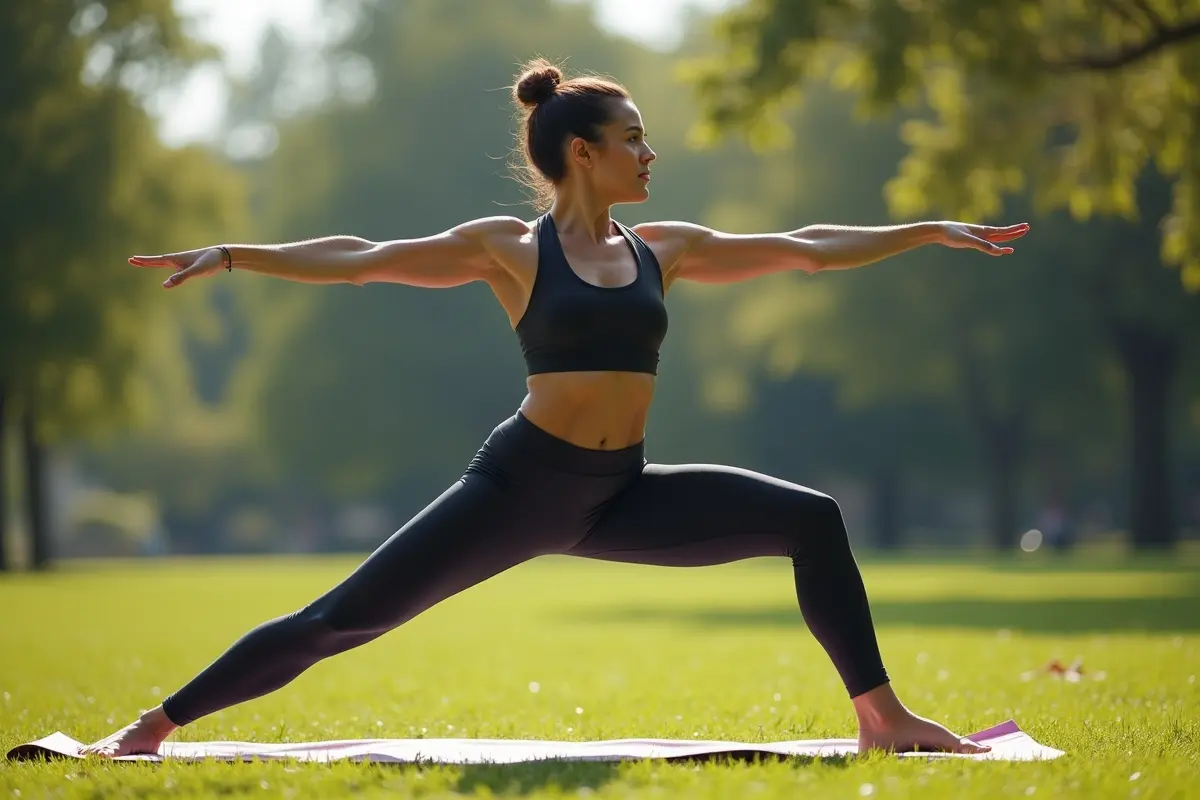
Yoga trains the complete kinetic chain at once. Doing a pose like Warrior II creates the necessary stability of the ankle, knee, hip, and shoulder to ensure the whole system is connected. Tree Pose helps develop the kind of proprioception regular gym programs neglect in the little stabilizers of the ankle and knee – stronger stabilizers around these joints means lower risk of ligament injury. This adaptation is far more critical than a 5kg increase in your squats.
Breathing As A Competitive Skill
Pranayama – the breath control practiced in yoga – doesn’t belong in the wellness section of an athlete’s training plan. It belongs in performance.
When you’re holding a difficult pose at the edge of muscular failure, your nervous system wants to panic. The practice is to breathe through it anyway – to stay regulated under physical stress. That’s exactly the skill required in the final minutes of a race or the pressure moments of a match. Athletes who train at yoga classes Sydney in a structured, expert-led environment learn to apply this breath-to-performance connection deliberately, not just during class.
The cortisol piece matters too. Yoga consistently lowers circulating stress hormones post-session, which accelerates the muscle repair process. For athletes training twice a day or carrying heavy competition schedules, that’s not trivial.
What Repetitive Sport Does To Posture – And How Yoga Corrects It
Swimming, running, and cycling do not strengthen opposing muscles and movements. In fact, the set of muscles and joint angles used in their execution makes the average practitioner weaker and less prepared for the next practice or race. But there is another reason every runner, swimmer, or cyclist should consider adding yoga to their training regime: over the long term, it will make you better at your sport.
This is a tricky argument because it is not short-term. Yoga makes athletes feel great pretty much immediately, but it tends to only filter into better performance over a longer period. This is because the patterns that each sport foster are deeply ingrained and take time to reset. But with consistent work, holding lengthened positions and moving more freely into the neglected ranges of motion, the typical swimmer, runner, or cyclist will feel the benefits of a more balanced body.
The Case For Adding Yoga To Your Training
Yoga is not a substitute for your conditioning work, it is a filler of the structural gaps created by the conditioning work. Stabilizers become stronger. Connective tissue becomes more resilient. The nervous system becomes better at regulating itself under load. Recovery increases.
The athletes who get the most out of yoga as cross-training are the ones who stay the healthiest over the longest period of time. And those who don’t view it simply as mobility work or an easy day are the ones who reap the most reward.